

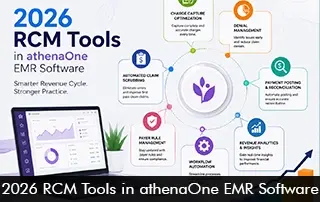
Revenue cycle management has become more complex than ever. Medical practices are burdened under rising denial rates, staffing shortages, and keeping up with changing payer requirements. On top of this, providers only want to focus on their patients to ensure they are receiving high-quality patient care. In response to these financial challenges, athenaOne EMR Software has expanded its revenue cycle management capabilities. The platform has revolutionized financial processes by integrating AI to make way for smarter workflows. It is a sigh of relief for clinicians, as now they can concentrate on patient care as tedious billing processes are streamlined with the athenaOne EHR platform.
Why Revenue Cycle Management Matters More in 2026
In 2026, healthcare organizations are facing the pressure to enhance their cash flow while also maintaining high-quality patient care. In an environment where costs are rising, maintaining financial stability is a challenge. Traditional billing systems will not work this year, as they require manual work, which can lead to denied claims and staff burnout.
To transform revenue cycle management, athenaOne EMR Software has embedded AI directly into its workflows to automate and streamline tedious medical billing tasks. The AI-native software is designed to reduce manual work and speed up payments.
Main RCM Tools in athenaOne EMR Software in 2026
The athenaOne EHR software is more than a medical billing software. The single solution steps in to address the core billing issues and hence helps practices thrive financially by meeting their goals. Let’s look at the key RCM features that are present in the athenaOne EMR platform.
AI-Powered Clams Management
In 2026, claims management has been revolutionized by using an AI-propelled claims engine. The athenaOne EMR software system efficiently analyzes payer behavior and claim outcomes across its network. The new intelligent system can identify claim issues before submission and enhance the claims acceptance rate. Cleaner claims are a dream come true for medical practices.
Denial Prevention
The revenue cycle management software can manage one of the biggest financial threats in healthcare—denials. In 2026, the athenaOne EHR platform has addressed this issue by taking a proactive approach in denials management. The robust platform can easily detect any coding issues and identify incomplete information before claim submission. This empowers practices to prevent denials before they happen and gives clinicians the chance to enhance healthcare delivery, which is their prime goal.
Intuitive Reporting tools
The simple-to-use reporting tools in the EMR software give a window of opportunity for users to get real-time visibility into their financial performance. The reports are a great way to see key metrics and benchmarks to assess if financial goals are met. Furthermore, the executive summary dashboard gives actionable insights on a single screen. This can give practice managers and billers the avenue to monitor financial performance and improvements.
Modernized RCM Tools that work in 2026 and Beyond
The major difference between the athenaOne EMR software and traditional billing software is that the RCM tools by athenaOne rely on predictive automation. This means that rather than waiting for financial issues to surface, the billing system identifies it and therefore prevents it before it can impact revenue.
This year the all-in-one billing solution has expanded RCM features of authorization management, medical coding with AAPC coding support, and reputation management tools. This makes the athenaOne platform a surefire hit to boost collections and automate processes to reduce staff burnout.