
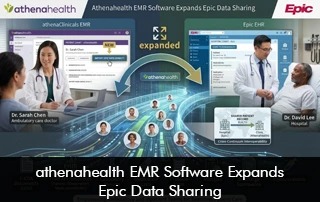
Healthcare technology is progressing greatly, and 2026 has been an innovative year for EMR software. To make way for connected healthcare, athenahealth EMR software has taken the initiative to collaborate with Epic Systems to enhance clinical data sharing across electronic health records software.
This announcement was made recently in November 2026, and it mainly focuses on ambulatory practices that want patient information access from different systems. The goal is to reduce the time spent by clinicians in finding patients’ medical history from external records. This can give providers a new opportunity to focus on their patients.
Why is athenahealth EMR software collaborating with Epic Systems?
Healthcare providers often treat patients who have visited other hospitals and specialists as well. However, getting access to their medical information can be a challenge, as the hospital may use different electronic medical records software.
To address these issues, athenahealth EHR software has joined hands with Epic Systems. This is an effort to make the exchange of clinical information friction-free, irrespective of the system used. Ultimately, improvements in interoperability can support better care coordination to reduce any gaps in care. So now the independent provider can have access to test results at a hospital that uses Epic EMR software.
How can Better Data Sharing Benefit Healthcare Providers?
To support the best treatment decisions, doctors need to have swift access to all patient information. Improved data exchange can enable ambulatory practices to access critical patient data from other healthcare organizations.
Better communication between athenahealth EMR software and Epic Systems can lead to more efficient clinical workflows. When two systems can communicate easily and transfer important data, the need for manual record requests is eliminated, and information can be accessed whenever needed.
Throughout their lifetime, patients move between specialists, primary care providers, hospitals, and diagnostic centers. Through robust interoperability, everyone involved in the patient care journey can stay on the same page. Clinicians can make confident decisions at the point of care and reduce gaps in patient care.
The expansion of data sharing between athenahealth EHR software and Epic EMR systems can create an environment where administrative work is streamlined. This can make meaningful impacts, as healthcare staff don’t have to spend time collecting and organizing medical records. With connected infrastructure established, staff members can focus on other patient services.
Interoperability—A Continued Focus of athenahealth EMR Software
Always keeping interoperability a priority, athenahealth EHR software continues to strengthen that vision. In early 2025, the company migrated all eligible providers on the athenaOne network to the Trusted Exchange Framework and Common Agreement (TEFCA).
The EMR software vendor has also expanded ChartSync, a capability available inside athenaOne EHR software. The experience is designed to allow users to access external information retrieved through TEFCA and other sources. These advancements in athenahealth EMR software can impact how patient information is exchanged and accessed. When health information becomes more accessible, it can be used to impact patient outcomes as well.
The collaboration between athenahealth software and Epic Systems demonstrates an important direction for US healthcare. We can see that modern platforms are increasingly expected to communicate seamlessly to alleviate the issue of data silos and make the entire ecosystem more interlinked than ever.